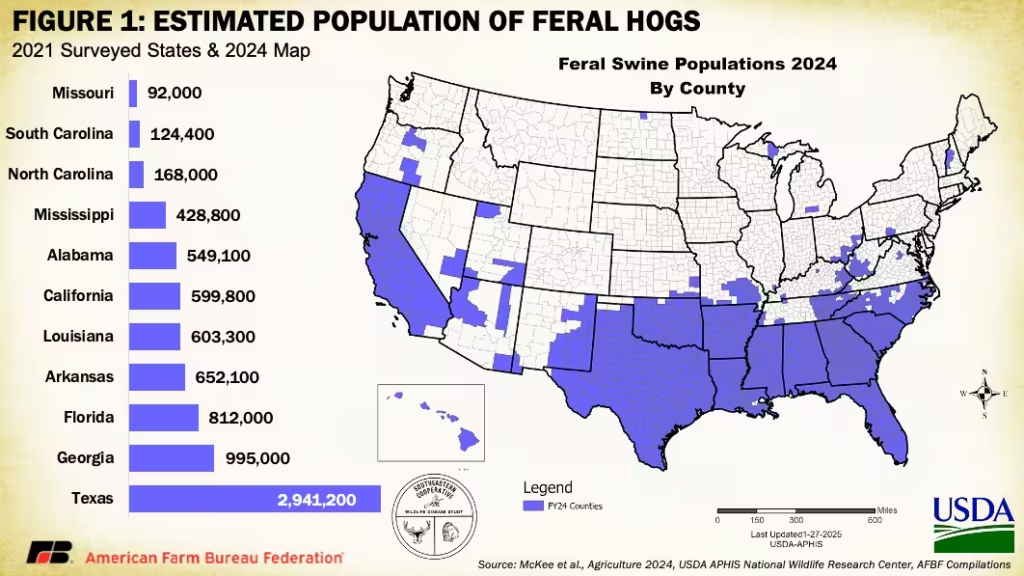
Pain: Wild pigs cause the largest documented ag costs in TX among surveyed states; crop farmers across 11 states faced $678M in one year, with Texas alone at ~$277M. The heaviest crop hits are corn (by value), sorghum (by share of production), and peanuts; many growers also change planting to avoid hog damage (lost profit).
Why now. Hog presence is widespread and rising in the South; risk is concentrated along field edges and watercourses—ideal for SafeScope’s zone-based deterrence.
2) Pasture-based cattle ranches (TX, OK, FL)
Pain. In 13 livestock states, hogs drove ~$193M in pasture damage, ~$375M in property damage (fences, roads, waterers, working pens), ~$266.6M in control costs, and ~$85M in direct livestock losses (predation, disease, vet/medical) in a single year. Cattle operations carry the biggest dollar losses (~$61M).
Mechanisms: pasture rooting (lost forage → extra feed), broken infrastructure, disease pressure, predation on newborns.
Why now. Ranchers need targeted, low-nuisance deterrence at water points, calving areas, and along fence lines—exactly where SafeScope’s local/offline loop excels.
3) GA/AL/FL corn–peanut–sorghum belts
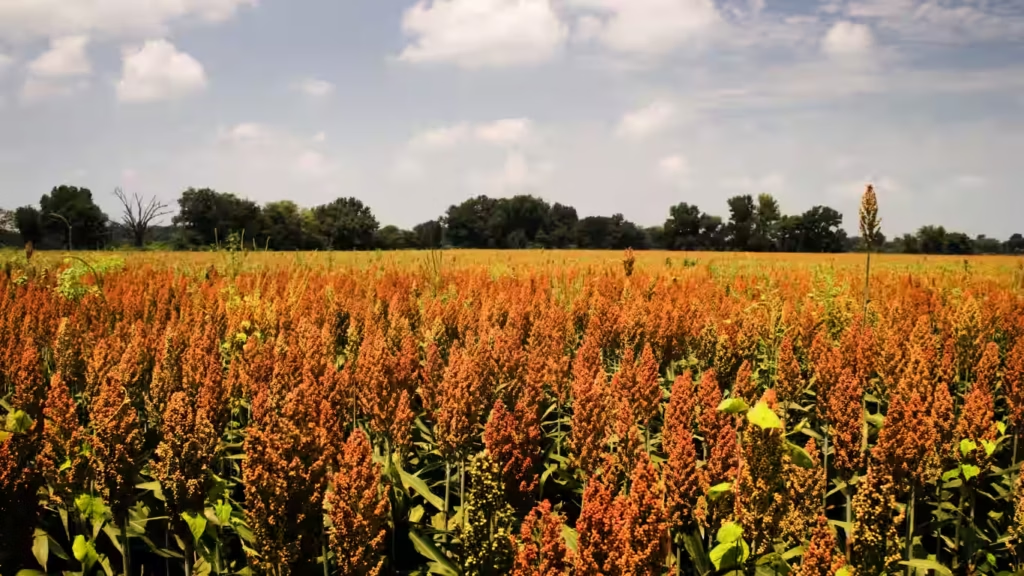
Pain. Within the 11-state crop study, corn had the highest dollar loss (~$92.2M), peanuts ~$38.5M, and sorghum the highest % loss (~6.4%) due to hogs. Significant foregone income (~$121.8M) from altering/avoiding preferred crops because of hog risk.
Why now. Producers in this region report increasing hog presence and are actively changing planting—clear ROI if SafeScope prevents those “total-wipe” nights along edges and bottoms.
4) Rice growers with levees & canals (TX/LA/AR)
Pain. Hogs breach levees, eat/tear up seedings, and damage irrigation infrastructure—high repair labor and timing penalties in rice systems; the 11-state crop study also documents rice losses from hog activity.
Why now. Nighttime, zone-specific deterrence at levee gaps and canal crossings reduces breaches without blanketing entire farms with alarms.
5) Sheep & goat operations in the Southern tier (TX/OK/GA)
Pain. Dual pressure: hogs (newborn predation, disease, pasture and fence damage) plus native predators. In the livestock survey set, hogs alone account for ~$85M direct livestock losses and heavy pasture/property costs in hog country—disproportionately borne by small-ruminant operations.
Why now. SafeScope’s species-targeted, zone-based deterrence near lambing/kidding sites and water points reduces night-time incidents without farm-wide nuisance.
Pain. Along many Southeast acres, cotton and corn face combined deer + hog pressure; recent Georgia coverage identifies deer as the #1 economic pest of cotton with ~$152M annual bite, while hog losses in the same states remain high—fields at timber edges get hit most.
Why now. For growers who can’t fence miles of perimeter, a perimeter-modular deterrence system that escalates locally when hogs appear is the practical middle ground.
7) Peanut producers in the Southeast (GA/FL/AL)
Pain. Peanuts are among the top three by dollar losses (~$38.5M) to hogs in the 11-state crop study; many growers report shifting away from peanuts in high-risk fields, sacrificing margin.
Why now. Targeted deterrence during critical pre-harvest windows reduces catastrophic row loss and avoids costly replant/foregone rotations.
8) Mixed farm–ranch operations in high-hog states (TX/GA/FL/OK)
Pain. “Two-front” problem—crops and livestock assets—so owners pay both sides of the ledger: crop losses + pasture/property damage + control labor. Combined, surveyed crop + livestock states spent ~$474M and >17M labor hours annually on hog control—just to hold the line.
Why now. SafeScope reduces night events with install-light hardware, quick time-to-value, and no dependency on continuous internet for protection.
Source notes
AFBF Market Intel (May 27, 2025). The single best roll-up of the latest USDA NFSDMP/NWRC/NASS hog-damage surveys: totals (e.g., $1.6B annual ag losses across 13 livestock states + 11 crop states), state-level map (e.g., TX ~$277M crop costs), category breakdowns for crops (e.g., $203.1M production losses, $121.8M foregone planting, $25.85M harvest disruption, $17.5M replanting, $102.9M property, $207.5M control) and livestock ($193M pasture, $375M property, $266.6M control, $85M predation/disease; cattle ~$61M). Also reports hog presence trends and state comparisons.
LSU AgCenter (2022). Practical guidance and documentation of hog damage to levees/irrigation in Louisiana rice systems—useful for rice-region messaging.
AgWeb / Farm Journal (Nov 26, 2024). Industry reporting that deer are now the #1 economic pest of cotton in Georgia with ~$152M annual impact; situational context for cotton-edge fields where deer + hog pressure stack. (Aligns with producer reports and Southeast extension commentary.)
SafeScope LLC
Revolutionizing security through AI-powered autonomous systems for agriculture, infrastructure, and wildlife protection.