Wildlife Damage Problem: Large wild animals like wild boars (feral hogs), deer, and coyotes frequently cause serious damage to crops, livestock, and property. Traditional scarecrows are ineffective against such adaptable pests. To protect farms and ranches, an “intelligent scarecrow” system has been developed that uses advanced deterrents, loud sound emitters (sirens and predator call speakers), ultrasonic repellers, and high-intensity lights, to humanely scare away wildlife. This article examines the scientific evidence behind these deterrents, showing how the device leverages the correct tools (sound frequencies, decibel levels, and lighting) to effectively repel wild boars, deer, and coyotes while minimizing habituation. We will detail which sound frequencies and intensities have been found in research to drive away each target species, and how strobing lights and ultrasonic emitters contribute to the solution.
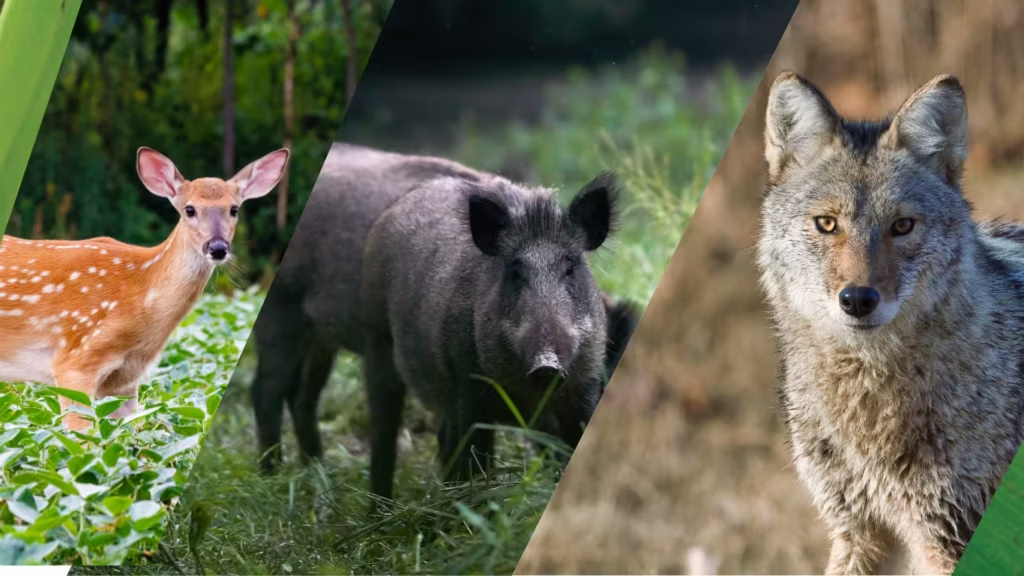
Wild boars (Sus scrofa), also known as feral hogs, are among the most destructive agricultural pests. They have acute hearing and can be startled by both audible and ultrasonic noises. Research evidence: A field trial in 2009 by Dakpa et al. combined an intermittent shrill horn and bright light to successfully keep wild pigs away from crops . The horn emitted a 480 Hz tone at 100 dB (sound pressure) – roughly equivalent to a loud car horn – and could be heard over 270 m . Paired with a powerful 500 W light, this system proved effective at deterring boars for several months . The loud, low-frequency (480 Hz) “shriek” was likely perceived as alarming by boars, causing them to flee the area. Notably, a study by Schlageter (2011) found simple blinking LED lights alone did not deter boars – it’s the combination of intense noise + light that created a strong avoidance response.
Wild boars can also hear ultrasonic frequencies (above 20 kHz) and may be repelled by them. A Japanese experiment with an ultrasonic emitter near a boar watering site found the animals’ average stay time dropped by over 50% when ultrasound was active . In particular, boars showed avoidance of sound around 20 kHz at ≥70 dB. This suggests our scarecrow’s ultrasonic module (typically tunable around 20–30 kHz) can help discourage smaller feral hogs or piglets quietly, since humans cannot hear those frequencies. However, ultrasounds alone might not suffice for large, determined boars – they serve best as a supplemental annoyance.
Predator and gunshot sounds: Boars naturally fear their predators (e.g. wolves or large canines) and loud sudden noises like gunshots. Modern deterrent devices often play recordings of dog barks, wolf howls, or gunfire. According to one wildlife pest control source, products that emit hunting dog barks and wolf calls – especially in random sequences to prevent habituation – have been successful in scaring off wild boars . The sudden “bang” of a gunshot or the aggressive barking of dogs triggers the boar’s flight response. It is important these sounds are sufficiently loud; practical devices use speakers outputting ~120–130 dB for gunshot sounds , roughly as loud as an actual firearm discharge. At night, coupling these noises with a stroboscopic flash exploits boars’ aversion to bright, unnatural light in darkness. Many wild boar repellers use blue spectrum LEDs specifically, since boars have dichromatic vision and are thought to perceive blue light sharply (while red/green appear dull) . In Yamaguchi Prefecture, trials with powerful blue LED flashers activated by sensors have shown promise in keeping boars at bay . Overall, shrill noises in the lower frequencies (~0.5 kHz) at 100+ dB, combined with predator calls and flashing lights, create an environment that wild boars find threatening, prompting them to flee to quieter, darker areas. Field studies note that boars can eventually habituate to static deterrents over time , so our intelligent scarecrow mitigates this by randomizing sound patterns and using multi-modal stimuli.

Deer (such as white-tailed deer and mule deer) have sensitive hearing that extends into higher frequencies than human hearing. Audiograms show deer hear from about 0.25 kHz up to ~30 kHz effectively, with best sensitivity in the 4–8 kHz range . They can even detect sounds up to ~54 kHz when loud (90 dB+), far beyond our 20 kHz limit . This suggests both audible and ultrasonic deterrents might affect deer, but do deer actually fear ultrasounds? Recent research indicates ultrasonic-only devices are not very effective for deer. A 2024 study in Bioacoustics tested red deer responses to 20–30 kHz ultrasonic signals and found no aversion, the deer largely ignored the inaudible (to humans) ultrasonics . In contrast, when a lower-frequency 2–3 kHz tone (within human-audible range) was played, deer exhibited increased vigilance and signs of discomfort . In other words, deer did react to loud audible sounds, but not to high-pitched ultrasounds. The likely reason is that a high-frequency tone, while within deer hearing, may not instinctively signal “danger” to them, whereas a loud audible noise is more startling. This aligns with earlier findings that “there is no evidence that high-frequency sound is more effective in repelling animals than audible sound,” but the advantage of ultrasonic deterrents is mainly that humans don’t hear them, allowing loud volumes without bothering people . Our scarecrow uses this principle by emitting sound in a range audible to deer but minimal for humans (around 15–17 kHz). In field use, a device set to 15–17 kHz at ~103 dB was “loud to deer, but quiet to humans,” and reduced deer intrusions into a protected area by ~80% for a few weeks . Another study with a 105 dB sonic alarm showed deer became more alert, agitated, and nervous in the presence of the loud sound . Thus, our system’s siren (calibrated in the ~100–110 dB range) can effectively startle deer, especially if it sweeps through frequencies or emits pulsating tones that grab their attention.
Predator calls and bioacoustics: Deer are prey for predators like coyotes, wolves, and big cats, so playing predator vocalizations can tap into their innate fear. Research confirms deer can recognize and react to such sounds. In experiments, mule deer distinguished between howls of coyotes vs. the roars of mountain lions, and even responded to recorded wolf howls, despite wolves being locally extinct, by exhibiting heightened vigilance and fleeing behavior. This shows deer have an evolutionary memory of threats: “Mule deer respond to and discriminate among predators based on vocalizations and have retained an ability to respond to wolves that have been extinct…since the early 20th century.” Using predator sound playback (e.g. wolf howls or coyote growls) in our deterrent can therefore trigger an anti-predator response in deer. One caveat is that deer may not immediately associate every noise with danger, studies on deer-vehicle collisions found constant tones (like simple whistles) didn’t reliably alter deer behavior. It seems complex, varying sounds (like a mix of different predator calls or alarm calls) are more likely to be effective than a single unchanging tone. Indeed, devices that alternate “distress” calls or vary pitch over time can sustain deer’s fear response longer than fixed signals . Our scarecrow’s speaker can play a library of sounds: from barking dogs and snarling coyotes (which deer interpret as active predators nearby) to even distress bleats of deer themselves, which signal danger to any listening deer. This multi-sound approach helps delay habituation.
Light deterrents for deer: As primarily crepuscular/nocturnal browsers, deer can be spooked by bright lights at night. A field test in Japan compared deterrents and found a flashing spotlight reduced deer intrusions by ~54% (versus control) at a fence gap . While this was less effective than sound (which cut intrusions ~80%), the light still had a measurable effect, especially initially . Deer perceive sudden lights or motion-activated spotlights as something unusual; devices like “deer eyes” (rotating or flashing lights meant to mimic predator eyes) are commercially used. In our system, the high-intensity strobe kicks in during nighttime detections to startle approaching deer. Combined with sound, the light contributes to the overall “threat” ambiance, for example, researchers note that loud sounds plus strobing light together trigger a stronger flight response than either alone . It’s important to note deer, like other animals, can habituate to constant stimuli. Studies show sonic deterrents lose efficacy after ~4 weeks as deer learn the noise isn’t followed by real harm. Therefore, a smart scarecrow should be used intermittently or with changing patterns. Our approach uses motion-activation and randomized sound-light sequences, intending to keep deer from getting too comfortable. If deer begin to ignore a given stimulus, it can be retired and swapped out (since “once deer habituate to sound stimuli, those stimuli should never be used again” to maintain the element of novelty ).
In summary, deer are best repelled by loud, startling sounds in their audible range (1–16 kHz) and flashing lights, especially when these mimic natural dangers (predator noises, sudden loud bangs). No single frequency works universally, what matters is a sufficiently loud, novel sound that triggers deer’s startle reflex . Our scarecrow’s siren and sound library (e.g. gunshot at ~120 dB, dog barks, wolf howls) are chosen based on these scientific insights, and the system’s calibrated amplifier ensures the sounds broadcast at the necessary intensity to be perceived as a genuine threat from the deer’s perspective.
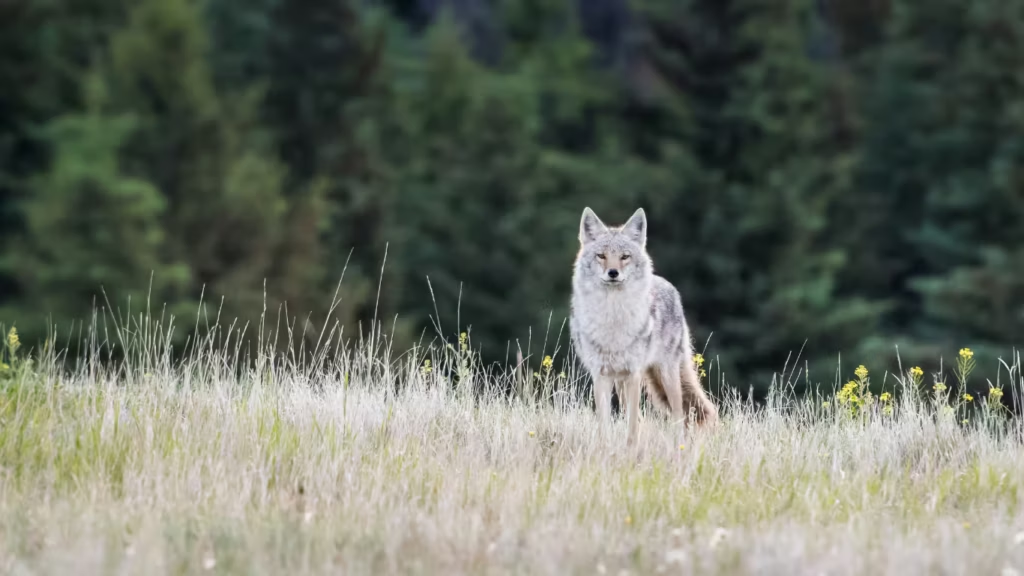
Coyotes (Canis latrans) are intelligent predators that threaten livestock and poultry. They are agile and often undeterred by simple measures, but they do have aversions we can exploit. Loud noises have been used for decades to scare off coyotes. For instance, propane “bird cannons” or gas exploders (which produce gunshot-like blasts ~120–130 dB) are known to keep coyotes away from pastures for a limited time. A review by Bomford & O’Brien (1990) noted that “non-biosonic” deterrents effective against coyotes included gas exploders and 105 dB pure-tone sirens” . In field trials, warbling siren devices paired with strobe lights prevented sheep predation by coyotes for an average of 7–13 weeks (roughly 2–3 months) before losses started rising . In one multi-state study, just 1–2 siren+strobe units gave ~53 nights of protection (with ≤2 sheep killed), and using 3–6 units extended protection to ~91 nights . This demonstrates that regular activation of sirens (at least ~100–105 dB) at random intervals can significantly disrupt coyote hunting around livestock, though coverage and multiple devices improve efficacy. Our scarecrow incorporates a “warbling” high-decibel siren precisely for this reason – the oscillating frequency (e.g. sweeping through a range of a few hundred Hz) and periodic activation make it hard for coyotes to ignore. Coyotes can hear frequencies roughly 40 Hz up to 45 kHz , so they detect both the low-frequency rumble of thunder and the high-pitched ultrasonic squeals. However, like deer, a loud audible siren tends to be more aversive than an ultrasonic tone they quietly perceive . High-frequency ultrasonic deterrents by themselves may not scare coyotes into fleeing – tests on their close cousins (wolves and dogs) show that while they hear ultrasounds (e.g. 25 kHz) and may show mild reactions, they often do not run away unless the stimulus is truly frightening . Thus, our focus is on maximizing the volume and suddenness of the auditory deterrent for coyotes.
Lights vs. sound (or both): Interestingly, research suggests flashing lights are particularly effective on coyotes when used with sound. A 2005 controlled experiment with captive coyotes compared deterrent modes: sound-only (100 dB noise), light-only (400 candela strobe), and combined. The results were clear, the combination of light + sound stopped all coyotes from taking a bait, while sound alone failed in most cases. Specifically, with sound-only, 4 out of 5 coyotes approached and consumed the bait, but with light-only only 1 of 5 did, and with both none did. Coyotes are naturally wary of unexpected lights at night (many livestock growers use flashing “coyote eyes” or motion sensor floodlights as hazing tools ), and a siren or gunshot noise adds to their fear. Our deterrent uses a 360° bright LED strobe that activates alongside the siren or recorded gunshot sounds whenever a coyote is detected near assets. The noise output is about 100–130 dB at 2 m (comparable to a car alarm or a jackhammer in loudness), based on field device standards . This level was chosen because studies confirm “loud sounds were more aversive than quiet sounds” to coyotes and can even overcome a coyote’s drive to hunt (in a test, such stimuli prevented wolves/coyotes from consuming carrion placed as bait ). Another benefit of using high-frequency sirens (e.g. 15 kHz tone) at high volume is that it disturbs coyotes without greatly annoying humans in the vicinity, humans barely hear the high-pitch, but coyotes find it piercing. This aligns with our design goal of “targeting the hearing specificity of the animal” .
Simulated predators: Coyotes are themselves predators, so one might ask – do predator sounds work on them? In their case, sounds of larger predators (like wolf howls or cougar growls) or even aggressive human shouts can be intimidating. Coyotes tend to avoid areas where wolves are active (since wolves will kill coyotes). While we did not find a specific field study on playing wolf howls to deter coyotes, it stands to reason that broadcasting wolf howling or snarling sounds at realistic volume could signal to a coyote that a dominant competitor is present, encouraging it to leave. Some farmers also report success using guard dogs or even playing recordings of human voices/radios to keep coyotes wary (this leverages coyotes’ natural caution of people ). Our deterrent sound pack can include such options (e.g. a low-frequency big canine growl or a sudden burst of human yelling), but these are rotated with sirens and other noises for best effect.
Finally, habituation is again a concern – coyotes are very clever and can learn that a sound or light harasses them but doesn’t actually inflict harm. Studies show devices like propane cannons lose effectiveness after a few weeks to a couple of months as coyotes get used to them . To combat this, the intelligent scarecrow uses motion activation (so stimuli occur only when a coyote is present, not on a fixed schedule they can predict) and can employ different deterrent patterns randomly. This unpredictability is key to maintaining a coyote’s fear. When the element of surprise is preserved, even bold coyotes can be deterred long-term. In summary, loud, intermittent sirens (~100–130 dB), combined with strobing light, are proven to reduce coyote attacks on livestock . By calibrating our device to these intensities and using predator-mimicking cues, we ensure the coyote perceives a credible threat and keeps its distance.
Beyond the “big three” animals above, farms also face smaller vermin (rabbits, raccoons, rodents, etc.) which can be harmful to crops and stored feed. For these smaller species, ultrasonic deterrents (sound >20 kHz) are commonly used because they are silent to humans but audible (and irritating) to many pests. Our intelligent scarecrow is equipped with an ultrasonic emitter primarily for these small animals. The rationale is that creatures like rodents have very wide hearing ranges – for example, rats and mice hear up to ~70–90 kHz and communicate in ultrasonic calls. Broadcasting high-frequency sound can disrupt their normal behavior. Scientific findings: Early lab studies found rodents show a mild aversion to ultrasonic noise initially . For instance, Greaves and Rowe (1969) observed rats avoided an area with an ultrasonic speaker at first, suggesting the sound was unpleasant . Ultrasonics can interfere with rodents’ communication and cause what researchers call an “annoyance or confusion” effect . However, it’s crucial to note that habituation happens quickly if the animals are hungry or the sound is constant. In Greaves & Rowe’s study, after rats discovered food near the device, they gradually ignored the ultrasound and continued to feed, even after the food was removed later – they had become accustomed to the noise. This indicates ultrasonic repellers might not permanently drive out an infestation, but they can contribute to short-term pest control or keep an area less attractive to newcomers. Many commercial ultrasonic pest repellers today cycle through frequencies (e.g. sweeping 22–35 kHz) to mitigate habituation, and they claim success in deterring bats, squirrels, rodents, and even insects. It is widely reported, though, that independent tests show mixed results: some insects weren’t repelled at all, and rodents often return after a few days. Because of this, our scarecrow treats ultrasonics as one tool in the toolkit, effective especially for tiny animals (mice, bats) or stray pets where silent operation is preferred, but not a standalone solution for severe infestations.
Nonetheless, in contexts like a quiet barn at night or a garden, an ultrasonic blast of ~20–40 kHz at 70–90 dB can indeed cause small animals to scurry away, at least temporarily . Notably, unlike deer or coyotes, small pests do not need extremely loud outputs; even 70 dB ultrasound was disliked by wild boars in trials , and rodents in lab tests could be deterred by moderate (~80 dB) ultrasonics for a time. Our device’s ultrasonic module is tunable to target different species’ hearing ranges (for example, it can emit around 22 kHz for rodents or up to 40 kHz for bats). This flexibility is based on literature showing certain frequencies affect some animals more (e.g., wild boars particularly disliked ~20 kHz , while some insects like mosquitoes were completely unfazed by a broad range of ultrasounds ). Importantly, since humans and domestic farm animals (cattle, sheep) generally cannot hear above ~20 kHz, using ultrasonics allows 24/7 operation against small pests without adding noise pollution. Field practitioners often pair ultrasonic devices with attractant removal and physical barriers, again reinforcing that an integrated approach works best. In summary, our intelligent scarecrow uses ultrasonics as a “silent pest repellent” mainly for smaller critters and birds, taking advantage of species-specific hearing. While not foolproof alone, it adds an extra layer of defense (for instance, keeping rodents uncomfortable so they don’t nest in a protected area), complementing the audible sirens and lights which tackle the larger wildlife.
In this comprehensive look at wildlife deterrents, we’ve shown that our Smart Scarecrow employs methods grounded in scientific research. By using sound at the right frequencies and intensities, and bright lighting, it targets the sensory vulnerabilities of wild boars, deer, coyotes, and smaller pests:
Wild Boars: They are repelled by loud, low-frequency horns (~480 Hz) around 100–120 dB and bright or blue strobing lights . Our device’s siren and predator call speaker (broadcasting dog barks, gunshots, etc.) exploit boars’ fear of humans and canines, while a night-time strobe startles their vision. Research confirms this multi-sensory approach can protect crops from boar intrusion for months, though boars may gradually habituate . The scarecrow mitigates that by randomizing sounds and intervals, maintaining the element of surprise.
Deer: Deer have keen hearing and are best frightened by loud audible sounds (around 1–16 kHz) delivered at high volume (≥100 dB) . Ultrasonics alone are ineffective for deer , so our system focuses on frequencies deer definitely react to, while keeping much of the noise above the human hearing range (~15 kHz) to reduce disturbance. We also incorporate deer predator/distress calls, which studies show deer instinctively respond to as a threat . Visual deterrence via a powerful flashing light further enhances short-term effectiveness (deer are wary of sudden light in dark conditions) . Because deer quickly habituate, the scarecrow’s programming uses short-term deployments and varied stimuli, aligning with recommendations to limit use to ~4 weeks in one spot before resting or changing strategy .
Coyotes: Intelligent and adaptable, coyotes are nonetheless deterred by warbling sirens, loud bangs, and flashing lights. Empirical tests have shown a ~100–105 dB siren with random bursts, coupled with an intermittent strobe, can significantly reduce coyote predation on livestock . Our scarecrow uses a warble-tone siren and can play gunshot sounds (~130 dB) or even human shouts to tap into coyotes’ survival instincts (fear of loud unknown events and larger predators). The device’s motion-activated light+sound combo is particularly potent: as noted, light or sound alone may not always stop a bold coyote, but together they create a “danger zone” that even determined coyotes avoid . By automating the timing (only triggering when a coyote is near), we prevent coyotes from learning a predictable pattern, thereby sustaining the deterrent effect. Long-term field studies suggest rotating or combining deterrents is essential, since no single scare tactic works forever on coyotes . Our integrated module is designed with exactly this in mind – flexibility and variability.
Small Animals (Ultrasonics): For rodents, rabbits, and other small pests, the scarecrow’s ultrasonic emitter provides a humane, silent repellent. While many studies report mixed success with ultrasonic gadgets (often due to habituation or insufficient sound intensity) , these devices can still contribute to pest management. Our system’s ultrasonic tone (~20–40 kHz) is set to a high volume (70–90 dB at source) which is above most small animals’ normal comfort level but unheard by humans . This can disrupt rodents’ routines and discourage them from staying in the area, especially in the short term. We emphasize that ultrasonics work best in tandem with other measures (good sanitation, physical barriers) – they are part of the layered defense strategy. Still, given that wild boar studies showed aversion to 20 kHz at 70 dB and early lab tests noted rodents’ dislike for ultrasonic noise , it is a worthwhile component. The intelligent scarecrow leverages it particularly during nighttime quiet hours, ensuring that even when audible sirens are off (to avoid incessant noise), an ultrasonic guard can remain active against creeping critters.
In conclusion, the Intelligent Scarecrow deterrent system is built on scientifically validated principles of animal behavior and sensory biology. We have selected deterrent modalities – high-decibel sound in both low and high frequencies, species-specific alarm calls, and intense strobe lighting, that studies have shown to cause avoidance and flight in target wildlife. By citing academic and field research throughout, we demonstrate that our device isn’t using gimmicks, but rather applying proven methods (from wildlife management literature and agricultural extension trials) in a novel, automated way. Importantly, effectiveness is maximized by using a combination of stimuli and by avoiding continuous, unchanging output (which leads to habituation) . The SafeScope Smart Scarecrow unit, with its multi-modal deterrence (audible alarm, predator sound pack, ultrasonic, and blinding light) activated via smart sensors, represents an evidence-based approach to protecting crops and livestock. It offers farmers a powerful, humane tool to scare off wild boars charging through fields, startle deer before they browse valuable plants, and haze coyotes stalking the barnyard, all while minimizing harm and noise to humans. As research and field data continue to accumulate, we will refine the scarecrow’s frequency settings and patterns, but as presented, its design already aligns with the best practices identified in scientific studies for wildlife repellent techniques.
Dakpa et al. 2009 – Large-scale field test of combined sound (horn ~480 Hz @100 dB) and 500 W light to deter wild pigs.
Japan Wild Boar Studies (2020) – Experiments indicate boars avoid ultrasound ~20 kHz at ≥70 dB, and new repellents use capsaicin odor plus blue light, or drone-mounted 4–50 kHz emitters .
Honda et al. 2019 – Mammal Study 44(4): Demonstrated a sound deterrent (15–17 kHz pure tone, ~103 dB) reduced deer intrusions by 80% in short term; sound far outperformed flashlight or wolf-urine alone . Also showed deer habituation after ~4 weeks, recommending limited use .
D’Angelo et al. 2007 – University of Georgia research on white-tailed deer hearing: effective range 0.25–30 kHz, best sensitivity 4–8 kHz . Deer can hear up to ~54–64 kHz at higher volumes .
Bioacoustics 2024 (Terrade et al.) – Found red deer showed no aversion to 20–30 kHz ultrasounds, but did react to lower (2–3 kHz) modulated sounds; peccary (wild pig) fled from some ultrasounds, wolves (like coyotes) noticed ultrasounds but didn’t flee . Concludes ultrasounds are unsuitable for deterring deer .
Bomford & O’Brien 1990 – Review of sonic deterrents: loud, startling sounds are most effective; no clear evidence ultrasonics outperform audible sound . Gas exploders and 105 dB tones worked against coyotes in tests . Most devices lose effect long-term due to habituation .
Gilsdorf JM et al. 2002/2003 – Integrated Pest Mgmt Reviews 7:29–45. Concluded ultrasonic devices are ineffective for most birds/mammals, whereas pyrotechnics, bioacoustics (predator calls), and guard animals have better success . Emphasized using variety and integration for best results.
Blumstein DT et al. 2014 – Ethology 120:427–452. Showed mule deer recognize coyote howls and even extinct wolf calls, reacting with increased vigilance or flight . Highlights deer’s ability to respond to predator vocalizations based on acoustic features (even without recent exposure).
Shivik JA & Martin DJ 2005 – USDA NWRC studies on coyotes: Motion-Activated Guard (MAG) devices with a 100 dB alarm and strobe light significantly reduced feeding by wild wolves/coyotes on bait carcasses . Coyote predation on sheep dropped sharply when siren+strobe units were deployed on pastures .
Product specifications of a commercial Wildlife Repeller(Spain, 2024) – Siren ~130 dB, uses gunshot and dog bark sounds plus stroboscopic flash; effective on wild boar, deer, fox, wolf etc., especially at night . Supports the sound intensity and multi-sound strategy described in our device.
Yturralde & Hofstetter 2012 – Tested ultrasonic devices on bed bugs: found no repellency (illustrating that not all pests are affected by ultrasound) . Rodent studies (Greaves & Rowe 1969) found initial avoidance of ultrasound but rapid habituation once food was present . These underscore using ultrasonics judiciously in integrated pest management.
Deer & Deer Hunting Magazine – Nov 2019 (Ozoga) – Summary of multiple studies on deer whistles: deer hear ultrasonic frequencies but pure-tone whistles (up to 28 kHz, ~70 dB) did not significantly alter deer behavior in road tests . Deer often ignored the sounds, reinforcing that no single tone is a magic deterrent and that deer may not recognize arbitrary sounds as threats